realm/SwiftLint: A tool to enforce Swift style and conventions.
Swift · · 21 min read · github.com ↗
SwiftLint
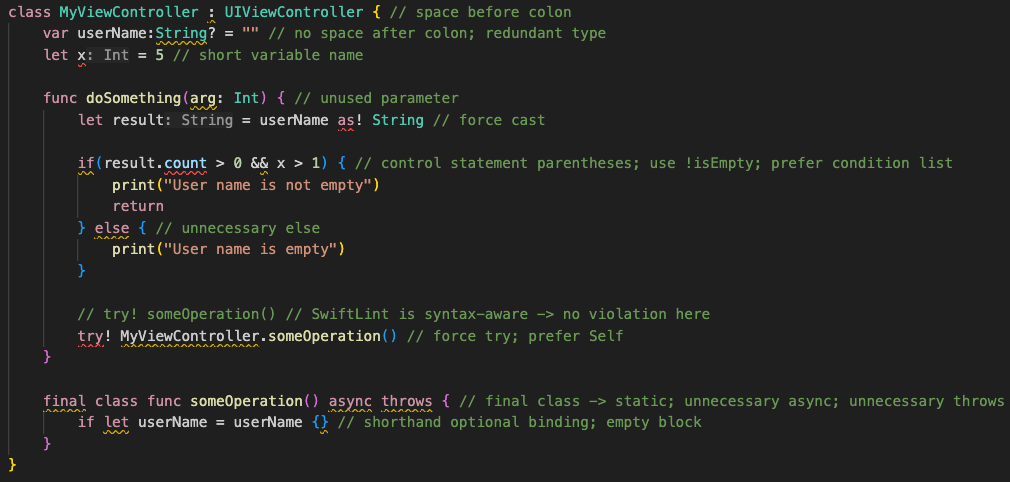
A tool to enforce Swift style and conventions, loosely based on the now archived GitHub Swift Style Guide. SwiftLint enforces the style guide rules that are generally accepted by the Swift community. These rules are well described in popular style guides like Kodeco's Swift Style Guide.
SwiftLint rules are predominantly based on SwiftSyntax. Some rules still hook into Clang and SourceKit to access type information.
This project adheres to the Contributor Covenant Code of Conduct. By participating, you are expected to uphold this code.
Video Introduction
To get a high-level overview of SwiftLint, we encourage you to watch this presentation recorded January 9th, 2017 by JP Simard (transcript provided):
Installation
Swift Package Manager
SwiftLint can be used as a command plugin or a build tool plugin.
Add
.package(url: "https://github.com/SimplyDanny/SwiftLintPlugins", from: "<version>")
to your Package.swift file to consume the latest release of SwiftLint automatically or pin the dependency to a specific version:
.package(url: "https://github.com/SimplyDanny/SwiftLintPlugins", exact: "<version>")
Therein, replace <version> with the desired minimum or exact version.
[!note] Note Consuming the plugins directly from the SwiftLint repository comes with several drawbacks. To avoid them and reduce the overhead imposed, it's highly recommended to consume the plugins from the dedicated SwiftLintPlugins repository, even though plugins from the SwiftLint repository are also absolutely functional. If the plugins from SwiftLint are preferred, just use the URL
https://github.com/realm/SwiftLintin the package declarations above.However, SwiftLintPlugins facilitates plugin adoption massively. It lists some of the reasons that drive the plugins as provided by SwiftLint itself very troublesome. Since the plugin code and the releases are kept in sync, there is no difference in functionality between the two, but you spare yourself a lot of time and trouble using the dedicated plugins repository.
This document assumes you're relying on SwiftLintPlugins.
Xcode Package Dependency
Use the following link to add SwiftLint as a Package Dependency to an Xcode project:
https://github.com/SimplyDanny/SwiftLintPlugins
Homebrew
brew install swiftlint
CocoaPods
Add the following to your Podfile:
pod 'SwiftLint'
This will download the SwiftLint binaries and dependencies in Pods/ during your next pod install execution and will allow you to invoke it via ${PODS_ROOT}/SwiftLint/swiftlint in your Script Build Phases.
Installing via Cocoapods also enables pinning to a specific version of SwiftLint rather than simply the latest (which is the case with Homebrew).
Note that this will add the SwiftLint binaries, its dependencies' binaries, and the Swift binary library distribution to the Pods/ directory, so checking in this directory to SCM such as Git is discouraged.
Mint
mint install realm/SwiftLint
Bazel
Put this in your MODULE.bazel:
bazel_dep(name = "swiftlint", version = "0.52.4", repo_name = "SwiftLint")
Or put this in your WORKSPACE:
WORKSPACE
load("@bazel_tools//tools/build_defs/repo:http.bzl", "http_archive")

http_archive(
    name = "build_bazel_rules_apple",
    sha256 = "390841dd5f8a85fc25776684f4793d56e21b098dfd7243cd145b9831e6ef8be6",
    url = "https://github.com/bazelbuild/rules_apple/releases/download/2.4.1/rules_apple.2.4.1.tar.gz",
)

load(
    "@build_bazel_rules_apple//apple:repositories.bzl",
    "apple_rules_dependencies",
)

apple_rules_dependencies()

load(
    "@build_bazel_rules_swift//swift:repositories.bzl",
    "swift_rules_dependencies",
)

swift_rules_dependencies()

load(
    "@build_bazel_rules_swift//swift:extras.bzl",
    "swift_rules_extra_dependencies",
)

swift_rules_extra_dependencies()

http_archive(
    name = "SwiftLint",
    sha256 = "c6ea58b9c72082cdc1ada4a2d48273ecc355896ed72204cedcc586b6ccb8aca6",
    url = "https://github.com/realm/SwiftLint/releases/download/0.52.4/bazel.tar.gz",
)

load("@SwiftLint//bazel:repos.bzl", "swiftlint_repos")

swiftlint_repos()

load("@SwiftLint//bazel:deps.bzl", "swiftlint_deps")

swiftlint_deps()
Then you can run SwiftLint in the current directory with this command:
bazel run -c opt @SwiftLint//:swiftlint
Pre-Built Package
Download SwiftLint.pkg from the latest GitHub release and run it.
From Source
Make sure the build tool Bazel and a recent Swift toolchain are installed and all tools are discoverable in your PATH.
To build SwiftLint, clone this repository and run make install.
Setup
[!important] Important While it may seem intuitive to run SwiftLint before compiling Swift source files to exit a build early when there are lint violations, it is important to understand that SwiftLint is designed to analyze valid source code that is compilable. Non-compiling code can very easily lead to unexpected and confusing results, especially when executing with
--fix/--autocorrectcommand line arguments.
Build Tool Plugins
SwiftLint can be used as a build tool plugin for both Swift Package projects and Xcode projects.
The build tool plugin determines the SwiftLint working directory by locating the topmost config file within the package/project directory. If a config file is not found therein, the package/project directory is used as the working directory.
The plugin throws an error when it is unable to resolve the SwiftLint working directory. For example, this will occur in Xcode projects where the target's Swift files are not located within the project directory.
To maximize compatibility with the plugin, avoid project structures that require the use of the --config option.
Swift Package Projects
[!note] Note Requires installing via Swift Package Manager.
Build tool plugins run when building each target. When a project has multiple targets, the plugin must be added to the desired targets individually.
To do this, add the plugin to the target(s) to be linted as follows:
.target(
    ...
    plugins: [.plugin(name: "SwiftLintBuildToolPlugin", package: "SwiftLintPlugins")]
),
Swift Package Command Plugin
[!note] Note Requires installing via Swift Package Manager.
The command plugin enables running SwiftLint from the command line as follows:
swift package plugin swiftlint
Xcode Projects
[!note] Note Requires installing via Xcode Package Dependency.
Build tool plugins run as a build phase of each target. When a project has multiple targets, the plugin must be added to the desired targets individually.
To do this, add the SwiftLintBuildToolPlugin to the Run Build Tool Plug-ins phase of the Build Phases for the target(s) to be linted.
[!tip] Tip When using the plugin for the first time, be sure to trust and enable it when prompted. If a macros build warning exists, select it to trust and enable the macros as well.
For unattended use (e.g. on CI), package plugin and macro validations can be disabled with either of the following:
- Using
xcodebuildoptions:-skipPackagePluginValidation -skipMacroValidation - Setting Xcode defaults:
defaults write com.apple.dt.Xcode IDESkipPackagePluginFingerprintValidatation -bool YES
defaults write com.apple.dt.Xcode IDESkipMacroFingerprintValidation -bool YES
[!important] Important The unattended use options bypass Xcode's validation dialogs and implicitly trust all plugins and macros, which has security implications.
Unexpected Xcode Project Structures
Project structures where SwiftLint's configuration file is located outside of the package/project directory are not directly supported by the build tool plugin. This is because it isn't possible to pass arguments to build tool plugins (e.g., passing the config file path).
If your project structure doesn't work directly with the build tool plugin, please consider one of the following options:
- To use a config file located outside the package/project directory, a config file may be added to that directory specifying a parent config path to the other config file, e.g.,
parent_config: path/to/.swiftlint.yml. - You can also consider the use of a Run Script Build Phase in place of the build tool plugin.
Xcode Run Script Build Phase
[!note] Note Based upon the installation method used, the shell command syntax in the Run Script Build Phase may be different or additional configuration could be required. Refer to the installation instructions for more information.
If the build tool plugin does not work for your project setup or when additional custom setup is required, SwiftLint can be added as a Run Script Build Phase. This is useful when a project setup relies on the --config SwiftLint option; or to lint all targets together in a single swiftlint invocation. File inclusions and exclusions can be configured in the .swiftlint.yml configuration.
To do this, add a custom script to a Run Script phase of the Build Phases of the primary app target, after the Compile Sources phase. Use the following script implementation:
if command -v swiftlint >/dev/null 2>&1
then
    swiftlint
else
    echo "warning: \`swiftlint\` command not found - See https://github.com/realm/SwiftLint#installation for installation instructions."
fi
If you're using the SwiftLintPlugin in a Swift package, you may refer to the swiftlint executable in the following way:
SWIFT_PACKAGE_DIR="${SWIFT_PACKAGE_DIR:-${BUILD_DIR%Build/*}SourcePackages}"
SWIFTLINT_CMD="$SWIFT_PACKAGE_DIR/artifacts/swiftlintplugins/SwiftLintBinary/SwiftLintBinary.artifactbundle/macos/swiftlint"

if test -f "$SWIFTLINT_CMD" 2>&1
then
    "$SWIFTLINT_CMD"
else
    echo "warning: \`swiftlint\` command not found - See https://github.com/realm/SwiftLint#xcode-run-script-build-phase for installation instructions."
fi
[!note] Note The
SWIFTLINT_CMDpath uses the default Xcode configuration and has been tested on Xcode 15/16. In case of another configuration (e.g. a custom Swift package path), please adapt the values accordingly. If you runxcodebuildwith-clonedSourcePackagesDirPath, setSWIFT_PACKAGE_DIRto<that path>before running the script.
[!tip] Tip Uncheck
Based on dependency analysisto runswiftlinton all incremental builds, suppressing the unspecified outputs warning.
Consideration for Xcode 15.0
Xcode 15 made a significant change by setting the default value of the ENABLE_USER_SCRIPT_SANDBOXING build setting from NO to YES. As a result, SwiftLint encounters an error related to missing file permissions, which typically manifests as error: Sandbox: swiftlint(19427) deny(1) file-read-data.
To resolve this issue, it is necessary to manually set the ENABLE_USER_SCRIPT_SANDBOXING setting to NO for the specific target that SwiftLint is being configured for.
Consideration for Apple Silicon
If you installed SwiftLint via Homebrew on Apple Silicon, you might experience this warning:
warning: SwiftLint not installed, download from https://github.com/realm/SwiftLint
That is because Homebrew on Apple Silicon installs the binaries into the /opt/homebrew/bin folder by default. To instruct Xcode where to find SwiftLint, you can either add /opt/homebrew/bin to the PATH environment variable in your build phase:
if <a href="/bookmarks/-"$(uname--m)"-==-arm64-" class="text-primary underline underline-offset-2"> "$(uname -m)" == arm64 </a>
then
    export PATH="/opt/homebrew/bin:$PATH"
fi

if command -v swiftlint >/dev/null 2>&1
then
    swiftlint
else
    echo "warning: \`swiftlint\` command not found - See https://github.com/realm/SwiftLint#installation for installation instructions."
fi
or you can create a symbolic link in /usr/local/bin pointing to the actual binary:
ln -s /opt/homebrew/bin/swiftlint /usr/local/bin/swiftlint
Additional Considerations
If you wish to fix violations as well, your script could run swiftlint --fix && swiftlint instead of just swiftlint. This will mean that all correctable violations are fixed while ensuring warnings show up in your project for remaining violations.
If you've installed SwiftLint via CocoaPods the script should look like this:
"${PODS_ROOT}/SwiftLint/swiftlint"
Visual Studio Code
To integrate SwiftLint with Visual Studio Code, install the vscode-swiftlint extension from the marketplace.
Fastlane
You can use the official swiftlint fastlane action to run SwiftLint as part of your fastlane process.
swiftlint(
    mode: :lint,                            # SwiftLint mode: :lint (default) or :autocorrect
    executable: "Pods/SwiftLint/swiftlint", # The SwiftLint binary path (optional). Important if you've installed it via CocoaPods
    path: "/path/to/lint",                  # Specify path to lint (optional)
    output_file: "swiftlint.result.json",   # The path of the output file (optional)
    reporter: "json",                       # The custom reporter to use (optional)
    config_file: ".swiftlint-ci.yml",       # The path of the configuration file (optional)
    files: [                                # List of files to process (optional)
        "AppDelegate.swift",
        "path/to/project/Model.swift"
    ],
    ignore_exit_status: true,               # Allow fastlane to continue even if SwiftLint returns a non-zero exit status (Default: false)
    quiet: true,                            # Don't print status logs like 'Linting ' & 'Done linting' (Default: false)
    strict: true                            # Fail on warnings? (Default: false)
)
Docker
SwiftLint is also available as a Docker image using Ubuntu. So just the first time you need to pull the docker image using the next command:
docker pull ghcr.io/realm/swiftlint:latest
Then following times, you just run swiftlint inside of the docker like:
docker run -it -v \`pwd\`:\`pwd\` -w \`pwd\` ghcr.io/realm/swiftlint:latest
This will execute swiftlint in the folder where you are right now (pwd), showing an output like:
$ docker run -it -v \`pwd\`:\`pwd\` -w \`pwd\` ghcr.io/realm/swiftlint:latest
Linting Swift files in current working directory
Linting 'RuleDocumentation.swift' (1/490)
...
Linting 'YamlSwiftLintTests.swift' (490/490)
Done linting! Found 0 violations, 0 serious in 490 files.
Here you have more documentation about the usage of Docker Images.
Command Line Usage
$ swiftlint help
OVERVIEW: A tool to enforce Swift style and conventions.

USAGE: swiftlint <subcommand>

OPTIONS:
  --version               Show the version.
  -h, --help              Show help information.

SUBCOMMANDS:
  analyze                 Run analysis rules
  docs                    Open SwiftLint documentation website in the default web browser
  generate-docs           Generates markdown documentation for selected group of rules
  lint (default)          Print lint warnings and errors
  baseline                Operations on existing baselines
  reporters               Display the list of reporters and their identifiers
  rules                   Display the list of rules and their identifiers
  version                 Display the current version of SwiftLint

  See 'swiftlint help <subcommand>' for detailed help.
Run swiftlint in the directory containing the Swift files to lint. Directories will be searched recursively.
To specify a list of files when using lint or analyze (like the list of files modified by Xcode specified by the ExtraBuildPhase Xcode plugin, or modified files in the working tree based on git ls-files -m), you can do so by passing the option --use-script-input-files and setting the following instance variables: SCRIPT_INPUT_FILE_COUNT and SCRIPT_INPUT_FILE_0, SCRIPT_INPUT_FILE_1,..., SCRIPT_INPUT_FILE_{SCRIPT_INPUT_FILE_COUNT - 1}. Similarly, files can be read from file lists by passing the option --use-script-input-file-lists and setting the following instance variables: SCRIPT_INPUT_FILE_LIST_COUNT and SCRIPT_INPUT_FILE_LIST_0, SCRIPT_INPUT_FILE_LIST_1,..., SCRIPT_INPUT_FILE_LIST_{SCRIPT_INPUT_FILE_LIST_COUNT - 1}.
These are same environment variables set for input files to custom Xcode script phases.
Working With Multiple Swift Versions
SwiftLint hooks into SourceKit so it continues working even as Swift evolves!
This also keeps SwiftLint lean, as it doesn't need to ship with a full Swift compiler, it just communicates with the official one you already have installed on your machine.
You should always run SwiftLint with the same toolchain you use to compile your code.
You may want to override SwiftLint's default Swift toolchain if you have multiple toolchains or Xcodes installed.
Here's the order in which SwiftLint determines which Swift toolchain to use:
$XCODE_DEFAULT_TOOLCHAIN_OVERRIDE$TOOLCHAIN_DIRor$TOOLCHAINSxcrun -find swift/Applications/Xcode.app/Contents/Developer/Toolchains/XcodeDefault.xctoolchain/Applications/Xcode-beta.app/Contents/Developer/Toolchains/XcodeDefault.xctoolchain~/Applications/Xcode.app/Contents/Developer/Toolchains/XcodeDefault.xctoolchain~/Applications/Xcode-beta.app/Contents/Developer/Toolchains/XcodeDefault.xctoolchain
sourcekitd.framework is expected to be found in the usr/lib/ subdirectory of the value passed in the paths above.
You may also set the TOOLCHAINS environment variable to the reverse-DNS notation that identifies a Swift toolchain version:
TOOLCHAINS=com.apple.dt.toolchain.Swift_2_3 swiftlint --fix
On Linux, SourceKit is expected to be located in /usr/lib/libsourcekitdInProc.so or specified by the LINUX_SOURCEKIT_LIB_PATH environment variable.
Git pre-commit Hook
SwiftLint can be run as a pre-commit hook. Once installed, add this to the .pre-commit-config.yaml in the root of your repository:
repos:
  - repo: https://github.com/realm/SwiftLint
    rev: 0.57.1
    hooks:
      - id: swiftlint
Adjust rev to the SwiftLint version of your choice. pre-commit autoupdate can be used to update to the current version.
SwiftLint can be configured using entry to apply fixes and fail on errors:
- repo: https://github.com/realm/SwiftLint
  rev: 0.57.1
  hooks:
    - id: swiftlint
      entry: swiftlint --fix --strict
Rules
Over 200 rules are included in SwiftLint and the Swift community (that's you!) continues to contribute more over time. Pull requests are encouraged.
You can find an updated list of rules and more information about them in the Rule Directory.
You can also check the Source/SwiftLintBuiltInRules/Rules directory to see their implementation.
Opt-In Rules
opt_in_rules are disabled by default (i.e., you have to explicitly enable them in your configuration file).
Guidelines on when to mark a rule as opt-in:
- A rule that can have many false positives (e.g.
empty_count) - A rule that is too slow
- A rule that is not general consensus or is only useful in some cases (e.g.
force_unwrapping)
Disable rules in code
Rules can be disabled with a comment inside a source file with the following format:
// swiftlint:disable <rule1> [<rule2> <rule3>...]
The rules will be disabled until the end of the file or until the linter sees a matching enable comment:
// swiftlint:enable <rule1> [<rule2> <rule3>...]
For example:
// swiftlint:disable colon
let noWarning :String = "" // No warning about colons immediately after variable names.
// swiftlint:enable colon
let hasWarning :String = "" // Warning generated about colons immediately after variable names.
Including the all keyword will disable all rules until the linter sees a matching enable comment:
// swiftlint:disable all // swiftlint:enable all
For example:
// swiftlint:disable all
let noWarning :String = "" // No warning about colons immediately after variable names.
let i = "" // Also no warning about short identifier names.
// swiftlint:enable all
let hasWarning :String = "" // Warning generated about colons immediately after variable names.
let y = "" // Warning generated about short identifier names.
It's also possible to modify a disable or enable command by appending :previous, :this or :next for only applying the command to the previous, this (current) or next line respectively.
For example:
// swiftlint:disable:next force_cast
let noWarning = NSNumber() as! Int
let hasWarning = NSNumber() as! Int
let noWarning2 = NSNumber() as! Int // swiftlint:disable:this force_cast
let noWarning3 = NSNumber() as! Int
// swiftlint:disable:previous force_cast
Run swiftlint rules to print a list of all available rules and their identifiers.
Configuration
Configure SwiftLint by adding a .swiftlint.yml file from the directory you'll run SwiftLint from. The following parameters can be configured:
Rule inclusion:
disabled_rules: Disable rules from the default enabled set.opt_in_rules: Enable rules that are not part of the default set. The specialallidentifier will enable all opt in linter rules, except the ones listed indisabled_rules.only_rules: Only the rules specified in this list will be enabled. Cannot be specified alongsidedisabled_rulesoropt_in_rules.analyzer_rules: This is an entirely separate list of rules that are only run by theanalyzecommand. All analyzer rules are opt-in, so this is the only configurable rule list, there are no equivalents fordisabled_rulesandonly_rules. The specialallidentifier can also be used here to enable all analyzer rules, except the ones listed indisabled_rules.
# By default, SwiftLint uses a set of sensible default rules you can adjust. Find all the available rules
# by running \`swiftlint rules\` or visiting https://realm.github.io/SwiftLint/rule-directory.html.

# Rules turned on by default can be disabled.
disabled_rules:
  - colon
  - comma
  - control_statement

# Rules turned off by default can be enabled.
opt_in_rules:
  - empty_count

# Alternatively, specify all rules explicitly by uncommenting this option and removing the above two.
# only_rules:
#   - empty_parameters
#   - vertical_whitespace

# Rules only run by \`swiftlint analyze\`. These are all opt-in.
analyzer_rules:
  - explicit_self

# Case-sensitive paths to include during linting. Directory paths supplied on the
# command line will be ignored. Wildcards are supported.
included:
  - Sources

# Case-sensitive paths to ignore during linting. Takes precedence over \`included\`. Wildcards
# are supported.
excluded:
  - Carthage
  - Pods
  - Sources/ExcludedFolder
  - Sources/ExcludedFile.swift
  - Sources/*/ExcludedFile.swift

# If true, SwiftLint will not fail if no lintable files are found.
allow_zero_lintable_files: false

# If true, SwiftLint will treat all warnings as errors.
strict: false

# If true, SwiftLint will treat all errors as warnings.
lenient: false

# The path to a baseline file, which will be used to filter out detected violations.
baseline: Baseline.json

# The path to save detected violations to as a new baseline.
write_baseline: Baseline.json

# If true, SwiftLint will check for updates after linting or analyzing.
check_for_updates: true

# Configurable rules can be customized. All rules support setting their severity level.
force_cast: warning # implicitly
force_try:
  severity: warning # explicitly

# Rules that have both warning and error levels can set just the warning level implicitly.
line_length: 110

# To set both levels implicitly, use an array.
type_body_length:
  - 300 # warning
  - 400 # error

# To set both levels explicitly, use a dictionary.
file_length:
  warning: 500
  error: 1200

# Naming rules can set warnings/errors for \`min_length\` and \`max_length\`. Additionally, they can
# set excluded names and allowed symbols.
type_name:
  min_length: 4 # warning
  max_length: # warning and error
    warning: 40
    error: 50
  excluded: i(Phone|Pad|Pod) # regex pattern
  allowed_symbols: ["_"]
identifier_name:
  min_length:
    error: 4 # only error
  excluded: # excluded via string array
    - id
    - URL
    - GlobalAPIKey

# The default reporter (SwiftLint's output format) can be configured as \`checkstyle\`, \`codeclimate\`, \`csv\`,
# \`emoji\`, \`github-actions-logging\`, \`gitlab\`, \`html\`, \`json\`, \`junit\`, \`markdown\`, \`relative-path\`, \`sarif\`,
# \`sonarqube\`, \`summary\`, or \`xcode\` (default).
reporter: "xcode"
You can also use environment variables in your configuration file, by using ${SOME_VARIABLE} in a string.
Defining Custom Rules
In addition to the rules that the main SwiftLint project ships with, SwiftLint can also run two types of custom rules that you can define yourself in your own projects:
1. Swift Custom Rules
These rules are written the same way as the Swift-based rules that ship with SwiftLint so they're fast, accurate, can leverage SwiftSyntax, can be unit tested, and more.
Using these requires building SwiftLint with Bazel as described in this video or its associated code in github.com/jpsim/swiftlint-bazel-example.
2. Regex Custom Rules
You can define custom regex-based rules in your configuration file using the following syntax:
custom_rules:
  # Rule identifier.
  pirates_beat_ninjas:
    # Optional regex that defines paths to include during linting.
    included:
      - ".*\\.swift"
    # Optional regex that defines paths to exclude during linting.
    excluded:
      - ".*Test\\.swift"
    # Optional rule name.
    name: "Pirates Beat Ninjas"
    # Matching pattern.
    regex: "([nN]inja)"
    # Number of regex capture group to highlight the rule violation at. Optional, defaults to 0 (the whole match).
    capture_group: 0
    # SyntaxKinds to match. optional.
    match_kinds:
      - comment
      - identifier
    # Optional violation message.
    message: "Pirates are better than ninjas."
    # Optional violation severity.
    severity: error
  no_hiding_in_strings:
    regex: "([nN]inja)"
    # Syntax kinds to match. optional.
    match_kinds: string
This is what the output would look like:

It is important to note that the regular expression pattern is used with the flags s and m enabled, that is . matches newlines and ^ / $ match the start and end of lines, respectively. If you do not want to have . match newlines, for example, the regex can be prepended by (?-s).
You can filter the matches by providing one or more match_kinds, which will reject matches that include syntax kinds that are not present in this list. Here are all the possible syntax kinds:
argumentattribute.builtinattribute.idbuildconfig.idbuildconfig.keywordcommentcomment.markcomment.urldoccommentdoccomment.fieldidentifierkeywordnumberobjectliteralparameterplaceholderstringstring_interpolation_anchortypeidentifier
All syntax kinds used in a snippet of Swift code can be extracted asking SourceKitten. For example, sourcekitten syntax --text "struct S {}" delivers
source.lang.swift.syntaxtype.keywordfor thestructkeyword andsource.lang.swift.syntaxtype.identifierfor its nameS
which match to keyword and identifier in the above list.
If using custom rules in combination with only_rules, you must include the literal string custom_rules in the only_rules list:
only_rules:
  - custom_rules

custom_rules:
  no_hiding_in_strings:
    regex: "([nN]inja)"
    match_kinds: string
Unlike Swift custom rules, you can use official SwiftLint builds (e.g. from Homebrew) to run regex custom rules.
Auto-correct
SwiftLint can automatically correct certain violations. Files on disk are overwritten with a corrected version.
Please make sure to have backups of these files before running swiftlint --fix, otherwise important data may be lost.
Standard linting is disabled while correcting because of the high likelihood of violations (or their offsets) being incorrect after modifying a file while applying corrections.
Analyze
The swiftlint analyze command can lint Swift files using the full type-checked AST. The compiler log path containing the clean swiftc build command invocation (incremental builds will fail) must be passed to analyze via the --compiler-log-path flag. e.g. --compiler-log-path /path/to/xcodebuild.log
This can be obtained by
- Cleaning DerivedData (incremental builds won't work with analyze)
- Running
xcodebuild -workspace {WORKSPACE}.xcworkspace -scheme {SCHEME} > xcodebuild.log - Running
swiftlint analyze --compiler-log-path xcodebuild.log
Analyzer rules tend to be considerably slower than lint rules.
Using Multiple Configuration Files
SwiftLint offers a variety of ways to include multiple configuration files. Multiple configuration files get merged into one single configuration that is then applied just as a single configuration file would get applied.
There are quite a lot of use cases where using multiple configuration files could be helpful:
For instance, one could use a team-wide shared SwiftLint configuration while allowing overrides in each project via a child configuration file.
Team-Wide Configuration:
disabled_rules:
  - force_cast
Project-Specific Configuration:
opt_in_rules:
  - force_cast
Child/Parent Configs (Locally)
You can specify a child_config and/or a parent_config reference within a configuration file. These references should be local paths relative to the folder of the configuration file they are specified in. This even works recursively, as long as there are no cycles and no ambiguities.
A child config is treated as a refinement and thus has a higher priority, while a parent config is considered a base with lower priority in case of conflicts.
Here's an example, assuming you have the following file structure:
ProjectRoot
    |_ .swiftlint.yml
    |_ .swiftlint_refinement.yml
    |_ Base
        |_ .swiftlint_base.yml
To include both the refinement and the base file, your .swiftlint.yml should look like this:
child_config: .swiftlint_refinement.yml
parent_config: Base/.swiftlint_base.yml
When merging parent and child configs, included and excluded configurations are processed carefully to account for differences in the directory location of the containing configuration files.
Path merging follows these rules:
included/excludedentries from each config are resolved relative to that config file's directory.- Child entries override conflicting parent entries.
- The merged path lists are computed as:
merged.included = (parent.included - child.excluded) + child.included
merged.excluded = (parent.excluded - child.included) + child.excluded
This means a child config can re-include a path excluded by its parent and can exclude a path included by its parent.
Child/Parent Configs (Remote)
Just as you can provide local child_config / parent_config references, instead of referencing local paths, you can just put urls that lead to configuration files. In order for SwiftLint to detect these remote references, they must start with http:// or https://.
The referenced remote configuration files may even recursively reference other remote configuration files, but aren't allowed to include local references.
Using a remote reference, your .swiftlint.yml could look like this:
parent_config: https://myteamserver.com/our-base-swiftlint-config.yml
Every time you run SwiftLint and have an Internet connection, SwiftLint tries to get a new version of every remote configuration that is referenced. If this request times out, a cached version is used if available. If there is no cached version available, SwiftLint fails – but no worries, a cached version should be there once SwiftLint has run successfully at least once.
If needed, the timeouts for the remote configuration fetching can be specified manually via the configuration file(s) using the remote_timeout / remote_timeout_if_cached specifiers. These values default to 2 seconds or 1 second, respectively.
Command Line
Instead of just providing one configuration file when running SwiftLint via the command line, you can also pass a hierarchy, where the first configuration is treated as a parent, while the last one is treated as the highest-priority child.
A simple example including just two configuration files looks like this:
swiftlint --config .swiftlint.yml --config .swiftlint_child.yml
Nested Configurations
In addition to a main configuration (the .swiftlint.yml file in the root folder), you can put other configuration files named .swiftlint.yml into the directory structure. For a given file, SwiftLint walks up from that file's directory towards the root configuration and uses the first nested .swiftlint.yml it finds as a child config.
That nested config applies only to files in its directory subtree. Files in other subtrees continue using the main config (or their own nearest nested config).
Because SwiftLint stops at the first match while walking up the directory tree, at most one nested configuration is merged per file (in addition to the main configuration).
.swiftlint.yml files are only considered as a nested configuration if they have not been used to build the main configuration already (e. g. by having been referenced via something like child_config: Folder/.swiftlint.yml). Also, parent_config / child_config specifications of nested configurations are getting ignored because there's no sense to that.
If one (or more) SwiftLint file(s) are explicitly specified via the --config parameter, that configuration will be treated as an override, no matter whether there exist other .swiftlint.yml files somewhere within the directory. So if you want to use nested configurations, you can't use the --config parameter.
License
About
SwiftLint is utterly maintained by volunteers contributing to its success entirely in their free time. As such, SwiftLint isn't a commercial product in any way.
Be kind to the people maintaining SwiftLint as a hobby and accept that their time is limited. Support them by contributing to the project, reporting issues, and helping others in the community.
Special thanks go to MacStadium for providing physical Mac mini machines to run our performance tests.

We also thank Realm (now MongoDB) for their initial contributions and setup of the project.